
Nutrient Guide
Calculate Your Dog's Daily Calorie Needs
Understand RER, MER, and DER formulas to accurately calculate your dog's daily calorie intake. Learn how to determine the right amount of food for their health.
Free tool — no sign-up
Enter weight, age and body shape: 30 seconds and you get the daily portion.
Dog's Daily Calorie Needs
Basic Concepts
RER (Resting Energy Requirement): RER = 70 × bodyweight_kg^0.75 — where bodyweight_kg = lb ÷ 2.2.
MER (Maintenance Energy Requirement): MER = RER × multiplier
DER (Daily Energy Requirement): Specific needs based on life stage.
MER Multipliers
| Condition | Multiplier |
|---|---|
| Inactive Spayed/Neutered | 1.2-1.4 |
| Inactive Intact | 1.4-1.6 |
| Moderately Active | 1.6-2.0 |
| Active | 2.0-3.0 |
| Working/Athletic | 3.0-5.0 |
| Puppy 0-4 months | 3.0 |
| Puppy 4 months-Adult | 2.0 |
| Pregnant (Last 3 Weeks) | ~2.0-2.4 (about 25-50% above maintenance) |
| Lactating | ~3.0-8.0 (about 2-4× maintenance, depending on litter size; peak in weeks 3-5) |
| Senior | 1.2-1.4 |
| Weight Loss (at target weight) | 1.0-1.2 |
| Weight Gain | 1.6-1.8 |
Example
66 lb (30 kg) spayed/neutered, moderately active adult Labrador:
- RER: 70 × 30^0.75 = 898 kcal
- DER: 898 × 1.6 = ~1437 kcal/day
- If food is 350 kcal/100g (~99 kcal/oz): 1437 ÷ 350 × 100 = ~14.5 oz / ~410 g/day
For Weight Loss
Use the target weight, not the current weight.
88 lb (40 kg) overweight, target weight 70 lb (32 kg):
- RER (at target weight): 70 × 32^0.75 = ~942 kcal
- DER for weight loss: 942 × 1.0 = ~942 kcal/day
Food Calorie Density
| Food Type | kcal/100g (~kcal/oz) |
|---|---|
| Standard Dry Kibble | 350-380 (~99-108) |
| Premium Dry Kibble | 380-420 (~108-119) |
| Light/Weight Control | 280-340 (~79-96) |
| Puppy | 380-450 (~108-128) |
| Senior | 320-380 (~91-108) |
| Canned Food | 80-130 (~23-37) |
| BARF/Raw | 130-180 (~37-51) |
Correction Factors
- Cold: +10-20% (outdoor dog)
- Hot: -10%
- Husky-type: higher metabolism
- Bulldog-type: lower metabolism
- From 7 years: -10-15%
- From 12 years: -15-25%
Meal Distribution
| Life Stage | Feedings/Day |
|---|---|
| 2-4 months | 4x |
| 4-6 months | 3x |
| 6 months+ | 2x |
| Diabetic | 2x (with insulin timing) |
| Pancreatitis | 4-6 small portions |
| Senior | 2-3x |
Portion Measurement
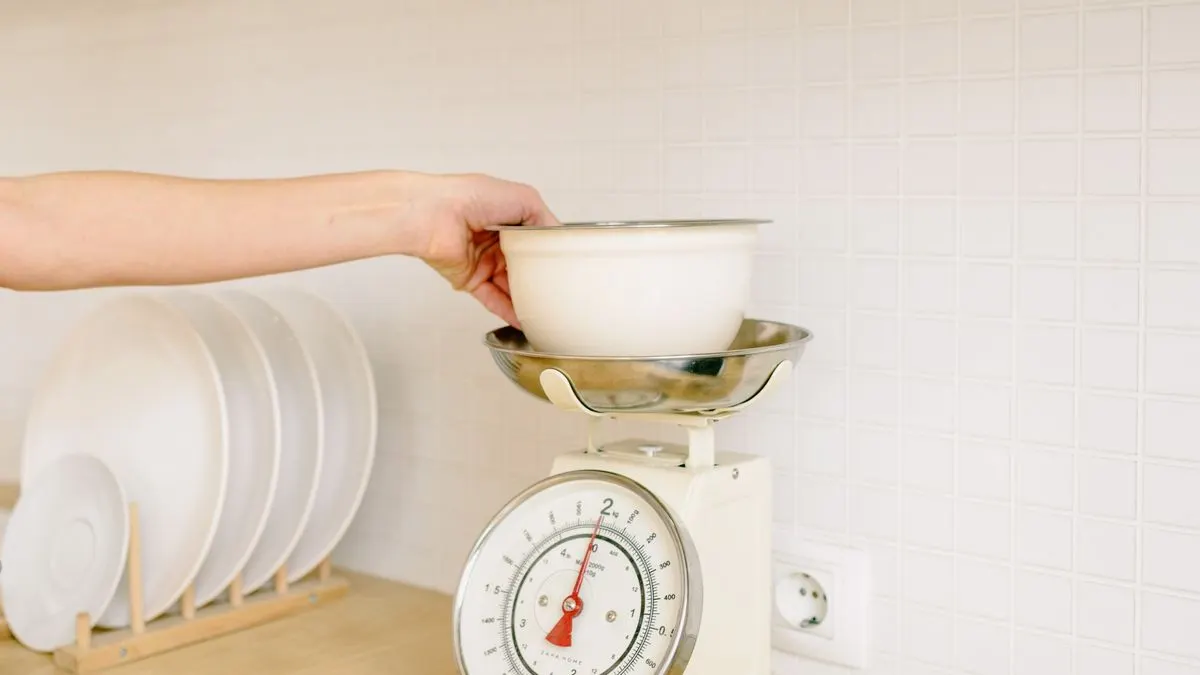
- Measuring cup: ±15-30% error
- Kitchen scale: ±5%
A scale is much more accurate, especially for weight loss.
Activity Levels
- Inactive: indoor dog, 30 min walk, minimal play
- Moderately Active: 1-2 hour walk, occasional running
- Active: More than 2 hours of walking, running
- Working/Athletic: agility, canine sports, competition dog
Free tool — no sign-up
Enter weight, age and body shape: 30 seconds and you get the daily portion.
References
- 1.National Research Council (US), Committee on Animal Nutrition — Nutrient Requirements of Dogs and Cats. National Academies Press, Washington DC, 2006. https://doi.org/10.17226/10668 (accessed: 2026-09-10)
- 2.FEDIAF (European Pet Food Industry Federation) — Nutritional Guidelines for Complete and Complementary Pet Food for Cats and Dogs. FEDIAF, 2024. https://europeanpetfood.org/self-regulation/nutritional-guidelines/ (accessed: 2026-09-10)
- 3.Cline MG, Burns KM, Coe JB, et al. — 2021 AAHA Nutrition and Weight Management Guidelines for Dogs and Cats. Journal of the American Animal Hospital Association 57(4):153–178, 2021. https://doi.org/10.5326/JAAHA-MS-7232 (accessed: 2026-09-10)
This is general information and does not replace a veterinary diagnosis.

This guide was compiled based on the expert input of Reka Fazekas-Birizdo canine nutritionist.
Certified Canine Nutritionist